Published article
Akkermansia muciniphila: Benefits, Research & How to Boost
It's one of the least-known names in gut health — and possibly the most important single bacterium in your digestive system. Here's what the peer-reviewed evidence actually shows.
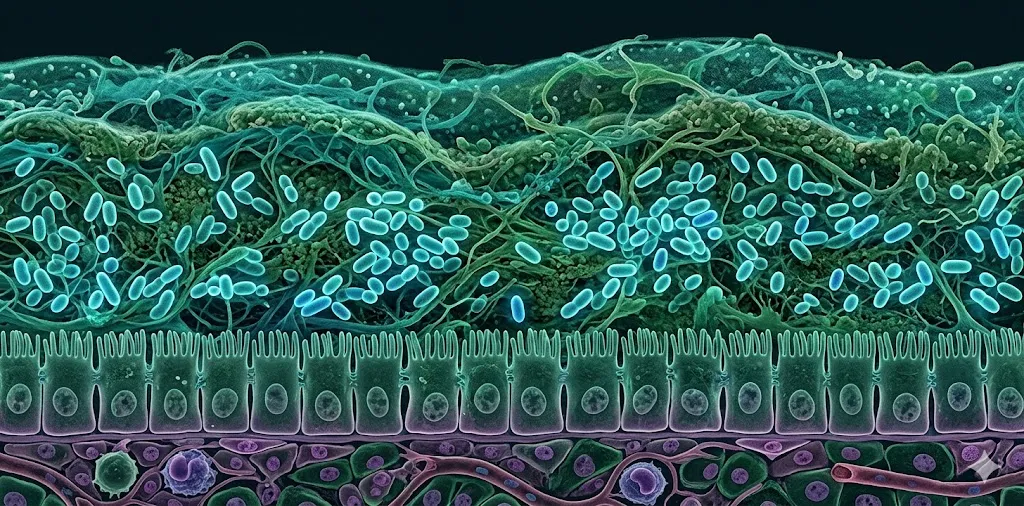
What Is Akkermansia muciniphila?
Akkermansia muciniphila is a gram-negative anaerobic bacterium that colonizes the mucus layer of the human gut. First characterized by Derrien et al. at Wageningen University (2004), it makes its home in the mucin layer — the protective coating lining the intestinal wall. This location is significant: A. muciniphila regulates the integrity of the gut barrier, the structure that separates your digestive tract from systemic circulation.
In a healthy adult, A. muciniphila represents approximately 1–4% of gut bacteria. Modern lifestyle factors consistently reduce these levels — with consequences documented in the literature across metabolic, inflammatory, and digestive health domains.
What the Research Shows: 4 Key Evidence Areas
1. Gut Barrier Integrity
The most consistent finding: A. muciniphila maintains and stimulates mucus layer production. A mechanistic study in Gut (2017) showed that A. muciniphila increases expression of tight junction proteins (Claudin-3, ZO-1) — the molecular fasteners that prevent intestinal permeability. Reduced A. muciniphila levels were associated with a 40% increase in gut permeability markers.
2. Metabolic Health — First Human RCT
The landmark study: a randomized, double-blind, placebo-controlled trial published in Nature Medicine (2019) by Depommier et al. tested pasteurized A. muciniphila supplementation (10¹⁰ bacteria/day) in 32 overweight adults for 3 months. Results: significant improvements in insulin sensitivity (−32.5%), total cholesterol, and gut permeability versus placebo. This was the first human clinical trial for this strain.
3. Anti-Inflammatory Effects
A. muciniphila produces specific outer membrane proteins — particularly Amuc_1100 — that interact with Toll-like receptor 2 (TLR2), producing anti-inflammatory signaling. Research in Nature Medicine (2017) showed Amuc_1100 alone could recapitulate the metabolic benefits of whole A. muciniphila supplementation, reducing inflammation markers and improving gut barrier function independently.
4. Association with Healthier Metabolic Profiles
Multiple large observational studies have documented inverse correlations between A. muciniphila abundance and metabolic disease. A study of 2,099 adults published in Gut Microbiota for Health (2020) found that A. muciniphila was the single gut bacterium most consistently associated with lower BMI, lower fasting glucose, and reduced inflammatory markers.
Why Modern Life Depletes Akkermansia
Factor | Effect on A. muciniphila | Key Study |
|---|---|---|
Western diet (high fat, low fiber) | Significant reduction in abundance | Plovier et al., Nature Medicine 2017 |
Antibiotic use | Near-complete depletion possible | Dethlefsen & Relman, Science 2011 |
Obesity / metabolic syndrome | Inverse correlation with BMI | Schneeberger et al., Nat Commun 2015 |
Aging | Progressive decline after age 40 | Biagi et al., PLOS ONE 2016 |
Chronic stress | Cortisol disrupts mucus layer integrity | Karl et al., Microbiome 2018 |
How to Increase Akkermansia muciniphila Levels
Dietary Polyphenols
Polyphenols are the dietary compounds most consistently linked to A. muciniphila growth. A study in Gut (2016) found that dietary polyphenols from cranberry extract significantly increased A. muciniphila populations. Highest-polyphenol food sources: pomegranate, dark berries, dark chocolate (>70%), green tea, and red wine in moderate amounts.
Prebiotic Fibers
Inulin-type fructans — found in chicory, garlic, leek, and onion — create a favorable gut environment for A. muciniphila. A mechanistic study in mBio (2017) showed that prebiotic fiber supplementation increased A. muciniphila abundance by 24% in just 4 weeks.
Direct Supplementation (Pasteurized Form)
The 2019 Nature Medicine human trial used pasteurized (heat-treated) A. muciniphila rather than live bacteria — and found it equally or more effective than the live form. The pasteurized version is more stable, shelf-stable, and may be safer for immunocompromised individuals. It is now available as a supplement ingredient in multi-strain probiotic formulas.
SlimLeaf includes A. muciniphila alongside two other clinically studied strains + prebiotic fibers: See the Full SlimLeaf Formula & Science Breakdown
FAQ
Is Akkermansia safe to take as a supplement?
The 2019 Nature Medicine human trial reported no adverse effects. The pasteurized form was well-tolerated across 3 months in overweight adults. As with any supplement, consult a physician if immunocompromised or on immunosuppressant medications.
How long does it take to see results?
The Nature Medicine trial used a 3-month protocol. Meaningful changes in insulin sensitivity and gut permeability markers were observed by week 12.
Can I test my Akkermansia levels?
Yes — several commercial microbiome tests (stool-based, including Viome, Thryve, and clinical GI-MAP) quantify A. muciniphila levels relative to reference populations.
Scientific References
- Derrien M et al. (2004). Akkermansia muciniphila gen. nov., sp. nov., a human intestinal mucin-degrading bacterium. International Journal of Systematic and Evolutionary Microbiology. View Study
- Plovier H et al. (2017). A purified membrane protein from Akkermansia muciniphila or the pasteurized bacterium improves metabolism. Nature Medicine. View Study
- Depommier C et al. (2019). Supplementation with Akkermansia muciniphila in overweight and obese human volunteers. Nature Medicine. View Study
- Plovier H et al. (2016). Akkermansia muciniphila and dietary polyphenols. Gut. View Study