Published article
Prebiotics vs Probiotics: The Science-Backed Guide
These two terms appear together constantly in gut health marketing — but most people couldn't explain what makes them different, or why combining them changes everything. Here's the definitive answer, backed by peer-reviewed evidence.
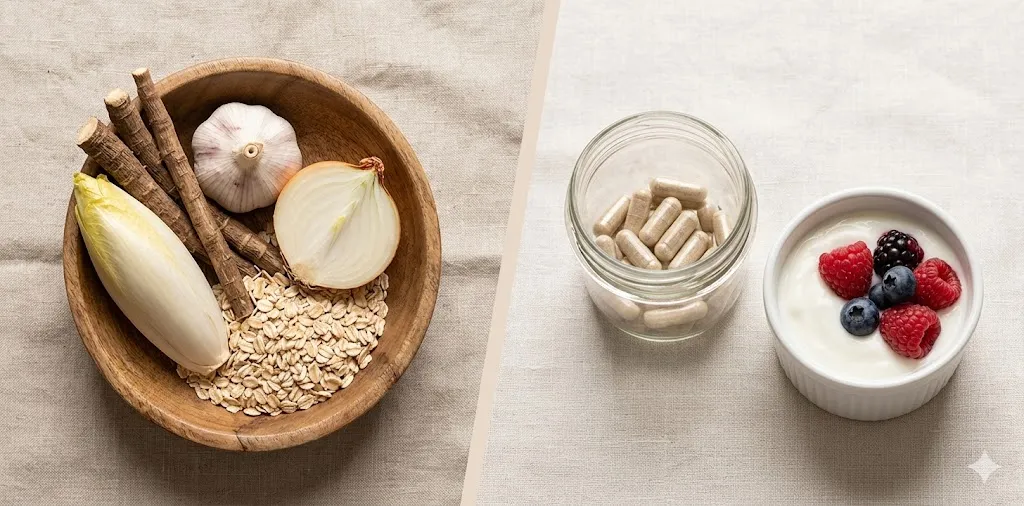
The One-Sentence Difference
Probiotics are live beneficial bacteria. Prebiotics are the fiber that feeds them. The research consistently shows that combining both — in what scientists call a 'synbiotic' — produces significantly better outcomes than either alone.
Probiotics: The Science-Backed Definition
The World Health Organization and FAO define probiotics as: 'live microorganisms that, when administered in adequate amounts, confer a health benefit on the host.' (WHO/FAO, 2001) The key qualifiers are 'live,' 'adequate amounts,' and 'documented health benefit.' A product with probiotic strains at sub-clinical doses doesn't technically qualify.
Clinically effective probiotic doses depend entirely on strain and condition. Most human RCTs use 1–100 billion CFU/day. Higher is not automatically better — some strains show optimal effects at 1 billion CFU, while others require 10–50 billion for measurable outcomes.
Prebiotics: More Specific Than Most People Realize
The current scientific definition (updated by the International Scientific Association for Probiotics and Prebiotics in Nature Reviews Gastroenterology & Hepatology, 2017) requires that a prebiotic must: (1) resist gastric digestion and reach the colon intact; (2) be selectively fermented by beneficial gut bacteria; (3) confer a measurable health benefit. Not all dietary fiber qualifies. The best-evidenced prebiotics are:
- Inulin and inulin-type fructans (found in chicory root, garlic, onion, leek) — most studied, strongest evidence
- Fructooligosaccharides (FOS) — closely related to inulin, well-documented bifidogenic effect
- Galactooligosaccharides (GOS) — derived from lactose, strong evidence for Bifidobacterium enrichment
- Resistant starch (RS2/RS3) — from cooked-cooled potatoes, green bananas, legumes — feeds Bifidobacterium and Akkermansia
Why the Combination Matters: Synbiotic Research
The most compelling evidence for prebiotic-probiotic combination comes from a meta-analysis of 32 RCTs published in Advances in Nutrition (2021). Synbiotic supplementation produced significantly better outcomes vs probiotic alone across five measures: microbiome diversity, colonization persistence, symptom relief, gut permeability markers, and inflammatory cytokine levels.
The mechanism is straightforward: prebiotic fibers selectively nourish the probiotic strains present, dramatically increasing their survival, colonization rate, and metabolic activity in the colon.
Head-to-Head Comparison
Factor | Probiotics alone | Prebiotics alone | Synbiotic (both) |
|---|---|---|---|
Colonization duration | Transient (days–weeks) | N/A (no bacteria added) | Prolonged (weeks–months) |
Microbiome diversity | Modest increase | Moderate increase | Strongest increase |
Effect speed | 2–4 weeks | 4–8 weeks | 2–4 weeks |
Evidence for IBS | Strong (strain-specific) | Moderate | Strongest |
Evidence for metabolic health | Moderate | Moderate | Strong |
Risk of side effects | Minimal (initial gas) | Minimal (initial gas) | Minimal |
Best Food Sources
Probiotic-rich foods
Food | Primary Strain | CFU Estimate |
|---|---|---|
Plain yogurt (live cultures) | L. acidophilus, B. lactis | 1–10 billion CFU/serving |
Kefir | Multiple Lactobacillus + yeasts | 10–50 billion CFU/serving |
Sauerkraut (unpasteurized) | L. plantarum, L. brevis | 1–10 billion CFU/serving |
Kimchi | L. kimchii, L. plantarum | 100M–10B CFU/serving |
Miso | A. oryzae (primarily) | Variable |
Prebiotic-rich foods
Food | Primary Prebiotic | Approx. dose per 100g |
|---|---|---|
Chicory root | Inulin | 41.6g |
Jerusalem artichoke | Inulin / FOS | 16–20g |
Garlic | FOS / Inulin | 9–16g |
Leek | FOS | 3–10g |
Cooked-cooled potato | Resistant starch | 5–6g |
Green banana | Resistant starch | 4–5g |
SlimLeaf combines inulin + resistant starch (prebiotics) with 3 clinical probiotic strains in one capsule: See the Full SlimLeaf Synbiotic Formula
FAQ
Can I take prebiotics without probiotics?
Yes — prebiotics benefit bacteria already present. However, if baseline microbiome diversity is low (post-antibiotics), prebiotics have less to nourish. Probiotics provide the bacteria; prebiotics ensure they survive.
What is a synbiotic?
A synbiotic is a supplement containing both probiotics and prebiotics, where the prebiotic specifically supports the probiotic strains included. The term was formalized by Gibson & Roberfroid in 1995 and updated by ISAPP in 2020.
Should I take probiotics before or after a meal?
Most evidence suggests taking probiotics with or just before a meal improves survival through gastric acid. Fat-containing meals may further buffer stomach pH, improving bacterial survival.
Scientific References
- WHO/FAO (2001). Health and Nutritional Properties of Probiotics in Food Including Powder Milk with Live Lactic Acid Bacteria. World Health Organization. View Study
- Gibson GR et al. (2017). Expert consensus document: The ISAPP consensus statement on the definition and scope of prebiotics. Nature Reviews Gastroenterology & Hepatology. View Study
- Markowiak P & Sliwewska K. (2021). Effects of Probiotics, Prebiotics, and Synbiotics on Human Health — Meta-analysis of 32 RCTs. Advances in Nutrition. View Study
- Roberfroid M et al. (2010). Prebiotic effects: metabolic and health benefits. British Journal of Nutrition. View Study